By: K. Johnson, J. Roby, L. Malo and F. Habiyaremye
ABSTRACT: In March 2025, the Northern Village of Puvirnituq in the Nunavik Region of northern Quebec, experienced a critical failure of the 5-kilometre supply line that provides raw water to the water treatment plant. The shallow buried urethane foam insulated High Density Polyethylene (HDPE) water supply line froze due to the failure of the heat trace freeze protection system during extremely cold weather. The incident triggered a major crisis in the village, forcing the temporary closure of the village’s primary school and necessitating the establishment of a crisis unit at the local hospital. During the period between the break and the installation of the temporary water supply line, trucks delivered untreated raw water directly to residents from the intake whenever possible. EXP was retained by the Kativik Regional Government (KRG) to problem solve, develop a temporary solution and assist with the temporary solution delivery. The emergency response consisted of a temporary overland flexible hose to bypass the sections of frozen pipe, completed over 10 days in April 2025. Following the water supply emergency EXP was also retained to complete a piped water and sewer distribution study for Puvirnituq. The elements of the study included:
- Identification of minimum requirements to provide piped level of services for above ground and below ground servicing schemes
- Analyses of water and sewer demands to determine capacity requirements
- Recommendations of piped servicing schemes
- INTRODUCTION
The Northern Village of Puvirnituq is a community in the Nunavik Region of northern Quebec. Nunavik is an area in Canada which comprises the northern third of the province of Quebec, part of the Nord-du-Québec region. Nunavik covers a land area of 440 thousand square kilometres north of the 55th parallel, it is the homeland of the Inuit of Quebec and part of the wider Inuit Nunangat. Almost all of the 14,000 inhabitants of the region, of whom 90% are Inuit, live in fourteen Northern Villages on the coast of Nunavik, which includes the east coast of Hudson Bay, the south coast of Hudson Strait and Ungava Bay (Johnson, 2008). Nunavik is governed on a regional basis by the Kativik Regional Government which is a non-ethnic public organization created in 1978, under the James Bay and Northern Québec Agreement. The organization has jurisdiction is municipal matters, transportation, the environment, policing, employment, labour training, income security, childcare services, renewable resources, land-use planning, civil security and economic development (KRG, 2020). The village of Puvirnituq is located on the east coast of Hudson Bay, in the Nunavik region of Northern Quebec, approximately 1,600 kilometres north of Montreal. The community has approximately 2,200 residents and operates on trucked water supply and trucked sewage collection (Quebec, 2026)
Puvirnituq is in a region of continuous permafrost, with areas that are highly susceptible to subsidence that is associated with permafrost thaw (Allard et al, 2018). Given its northern location, the community is particularly isolated and can only be accessed year-round by air, and seasonally by the annual sealift. Puvirnituq experiences a harsh Arctic climate with long, very cold winters and short, cool summers. Winter weather lows average around -26 °C in February, and summer highs average 11 °C in July (WeatherSpark, 2026).
- EXISTING WATER SUPPLY SYSTEM
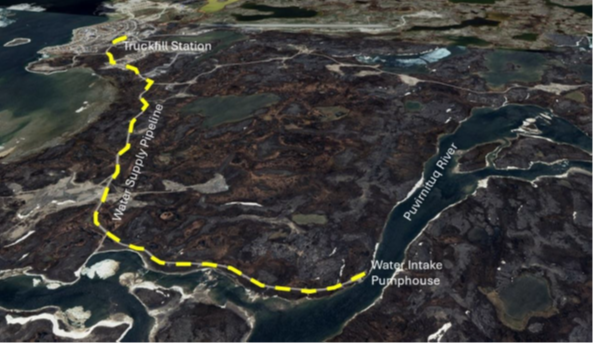
The Puvirnituq water system consists of a raw water supply system, a water treatment plant and the trucked water distribution system. Raw water is pumped from an intake pumphouse on the Puvirnituq River northeast from the community core. The raw water is pumped from the pumphouse at the edge of the river approximately 5.3 km, through a buried, insulated and heat traced water supply line to a water treatment and storage facility with truck fill located in the Village. The water supply line is located along the outside edge of an access road to the water supply intake (EXP, 2025)
At the water treatment plant, the water is stored in a storage tank that holds both operational and fire suppression volumes. The water treatment in Puvirnituq consists of filtration, UV and chlorine disinfection (EXP, 2025).
The community currently uses a trucked system for water delivery and sewage collection to the approximately 1,080 individual buildings in the community and 2,200 residents. Each building has a tank for potable water and a holding tank for sewage. The tanks are filled or emptied on a scheduled day for each building. The one exemption to the trucked servicing is the Puvirnituq Health Centre, which has a direct line connecting the health facility to the water treatment plant (EXP, 2025).
- WATER SUPPLY EMERGENCY
3.1 Critical Failure of the Water Supply and Emergency Solution
In March 2025, the community experienced a critical failure of the 5-kilometre raw water supply line to the community. The shallow buried water supply line froze due to extremely cold weather and the failure of the heat trace freeze protection system.
The incident triggered a major crisis in the village, forcing the temporary closure of the primary school and subsequently the premature end of the school year. The situation was also very problematic at the local regional hospital, necessitating the establishment of a crisis unit due to the complete lack of water for many days at a time or the usage of untreated water (CBC, 2025). During the period between the supply line freezing and the installation of the temporary water supply line, trucks delivered untreated raw water directly to residents from the intake, which is 5 km from the community, whenever possible.
3.1.1 Temporary Solution Considerations
To achieve a viable temporary solution, measures were taken to minimize the risk of freezing for the temporary pipe. If the temporary pipe was not installed on flat ground, it would bend and increase pressure drops, which would significantly reduce flow and increase the risk of the pipe freezing. The flow of water in the temporary pipe needed to be maintained continuously during outside temperatures below 0 °C. When using the temporary line, the flow rate at the pumping station and the pressures between the pumping station and the water treatment plant in dynamic mode would need to be carefully monitored. Alarms were programmed to provide remote monitoring. The increase in the pressure differential between the pumping station and the water treatment process plant as well as the reduction in flow would be signs of a problem causing losses or restrictions such as freezing, air in high points, bent pipe and significant leaks in the system.
3.1.2 Temporary Pipe Route and Installation
The route that the temporary water supply pipeline should take was carefully considered. Installing the temporary pipe south of the roadside utility poles was not recommended because the terrain is not sufficiently flat and snow blowing would be a concern. In addition, when the snow melted, the natural terrain is invariable with rocks, shrubs, etc. Installing the temporary pipe on the roadway under existing conditions was also not recommended — the road is narrowed due to the snowbanks and the pipeline would inevitably be broken by trucks, plows, snowmobiles, etc. Ultimately, the road path was widened to reserve part of the path for driving, and the temporary pipe was identified by stakes to locate and protect it. To protect the pipe at vehicle crossings, a rigid external pipe or sections of wood around the pipe were used.
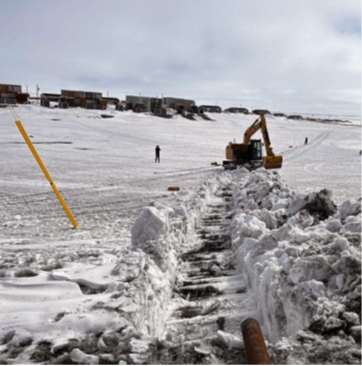
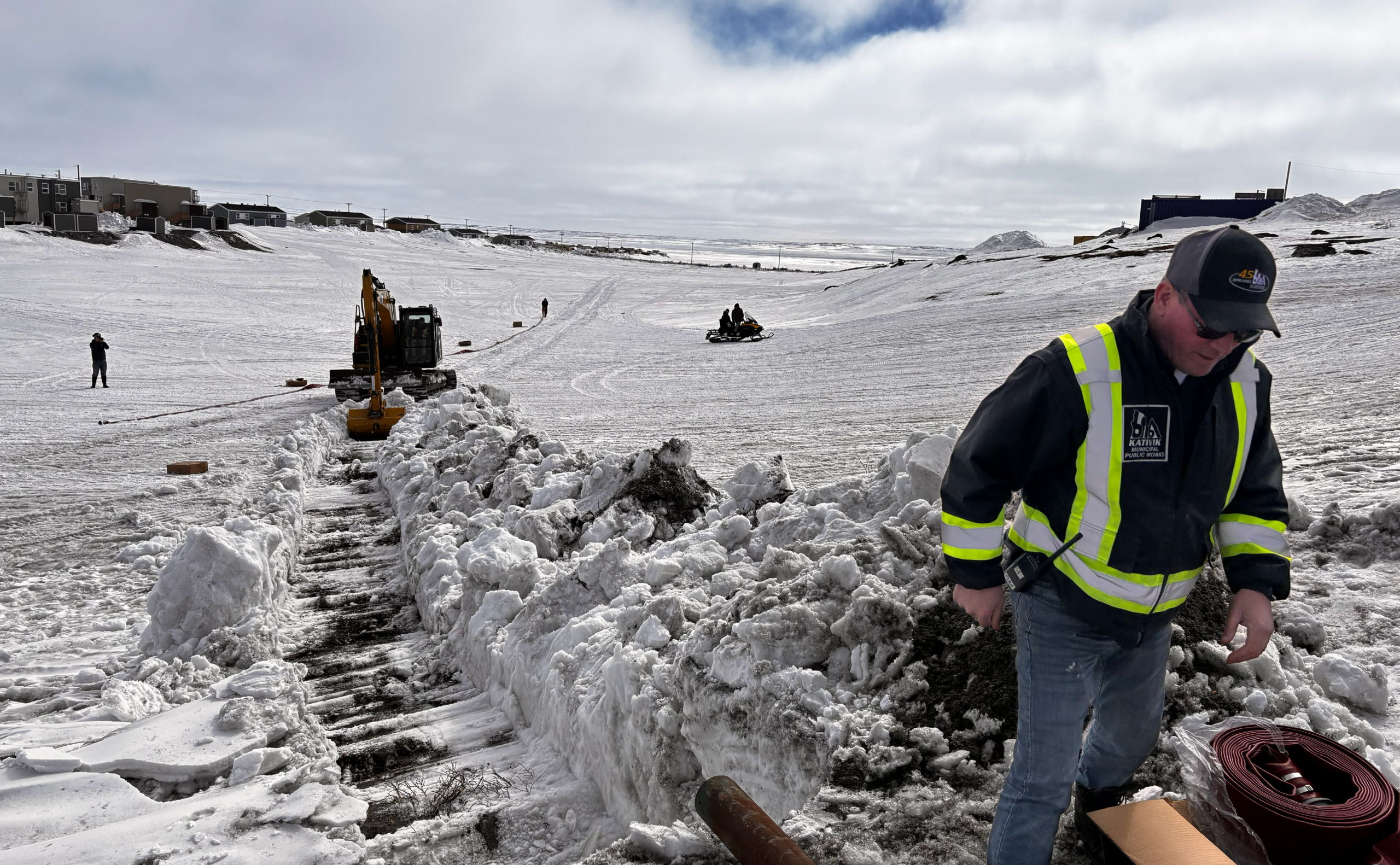
The emergency response consisted of a temporary overland flexible hose to bypass the sections of frozen pipe. The work was undertaken by KRG staff with EXP providing oversight to the construction. The temporary pipe replacement was completed in a period of ten days in April.
- PIPED INFRASTRUCTURE SYSTEM STUDY
4.1 Trucked vs Piped System
A committee was formed between KRG, Northern Village of Puvirnituq (NV), Povungnituk Co-operative Association (COOP) and Société du Plan Nord (SPN) (Committee) with the objective to increase the water and sanitation level of service for the Village of Puvirnituq from the existing trucked water distribution and sewage collection system to a piped system to serve the entire community. The Committee has concerns over the continuing use of the trucked systems and is interested in the potential advantages that a pipe system may offer, which include: higher reliability than trucked services; fire suppression capability with fire hydrants; flexibility in response to changes in service demand; lower operating and maintenance costs than trucked services; and potential improvement to public health for water-washed diseases because of increased per capita water use.
4.2 Above vs Below-Ground Configuration
Two fundamental options that are considered in the design of piped Arctic infrastructure are a below-ground configuration used in the water and sewer systems in southern Canada, and an above-ground configuration which is used exclusively in the Town of Inuvik, Northwest Territories (NWT).
4.2.1 Below-Ground Configuration
Below-ground Arctic water and sewer servicing is a well-developed technology that has been applied in several regions and communities in the Canadian Arctic, including Dawson City, which has used a below-ground configuration for over 100 years. The communities of Iqaluit and Resolute have been operating below-ground systems since the mid 70’s, and Rankin Inlet has been operating a buried piped system since the mid 80’s. The design of below-ground servicing in the Arctic has benefited from more than a century of evolution of the various components of the water and sewer systems, the operation and maintenance of these components and the construction of the systems. This includes a system of insulated water and sewer mains, a network of dual water mains for freeze protection using water recirculation, access vaults (manholes) for water and sewer, dedicated hydrants and service connections for water and sewer to the individual buildings.
The current best practice for water and sewer main construction is to install the mains with a minimum 3 m of cover from the finished grade to the top of the pipe. This is done to reduce the influence of seasonal dynamic thawing processes of permafrost and to reduce pipe deformation and collapse due to external pressure during freeze-back. Historically, mains have been installed at shallower depths and within the active layer, however the increasing experience with the soil dynamics of the active layer have pushed the depth of burial as well as provisions for reestablishing and protecting the permafrost zone once the below-ground system has been installed.
Issues associated with below-ground servicing include ground conditions, active layer considerations, system access and system access locations, pipe profile, excavation and freeze protection. Ground conditions influence the long-term reliability because pipe grade is critical to maintaining sewage flow. A pipe placed in the active layer is subjected to the dynamics of freezing and thawing soil which may change the pipe grades and therefore special provisions are required to make sure that any installed pipe is not prone to freeze thaw soil dynamics. Access to the piped system is required and is accommodated with access vaults (AVs), which are robust insulated and welded containers. Access vault locations must be selected to provide access to operating equipment while minimizing exposure to damage from traffic and snow removal. The profile of the water and sewer mains represents a compromise between thermal and ground stability, and ease of excavation both for initial installation and future repairs must be considered. All repairs to the main piping and service connections will require excavation in a below-ground system and may require excavation of frozen ground throughout the year. Freeze protection of the water supply may be required for two-thirds or more of the year from November through May.
4.2.2 Above-Ground Configuration
In Arctic Canada, the only community to utilize an above-ground configuration for water and sewer is the Town of Inuvik. The Inuvik water and sewer system was developed in the early 1960’s and was designed as an above-ground system because of the ice-rich soil conditions, which would have produced significant ground movement for a buried system. The original above-ground system was installed in a metal box which contained district heating and the water and sewer systems. This system was stable from the deterioration of the ground ice. The modern version of this system involves individually insulated water and sewer piping instead of boxed utilidors so that the pipes are easier to seal against water and air infiltration.
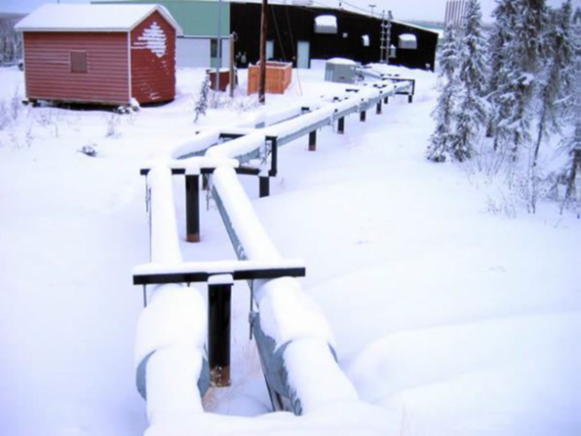
Due to the exposed nature of the individual piping, mechanical and ultraviolet protection must be included in the design. These protections can include metal jackets or shallow buries.
Above-ground systems are less vulnerable to the dynamic soil conditions of an ice-rich buried system and provides better management of area drainage and property development.
Issues associated with above-ground servicing include pipe profile and grading, road crossings, gravity drainage and freeze protection. Pipe profile and grading must be integrated into the final grading of the site to make sure appropriate gradients for the flow in the sanitary sewers. Above-ground systems are placed on a pile supported system and thus the design of road crossings requires careful attention to detail, including providing a suitable casing for the crossing, adjustment to road grade to accommodate the crossing and provision for drainage at the crossing. Gravity drainage of sanitary sewage from the existing buildings requires allowance for the main diameter, fittings at the main and house and sufficient slope from the house to the main. The resulting floor elevation is approximately a minimum of 1.2 metres above the main invert. Above-ground servicing is exposed to the extremes of winter temperatures and wind. During the coldest periods of the winter, above-ground servicing will experience approximately three times the heat loss of that experienced by a below-ground system and therefore freeze protection requirements are increased.
4.2.3 Configuration Recommendation
Below-ground servicing represents a mature and proven water and sewer servicing strategy. For the Village of Puvirnituq, no compelling reason for above-ground servicing was identified as part of the information and assessment in the study. Above-ground servicing carries several substantial negative implications, including impact upon community development, high rates of heat loss during winter (i.e. high rates of bleed water input to the sewers) and high vulnerabilities to negative impacts caused by thawing permafrost. Based on the issues presented above, below-ground servicing was selected as the preferred installation method for the proposed piped system. This installation would incorporate the evolution and improvements in below-ground servicing that address ground movement associated with permafrost, freeze protection, and access vaults. The elements associated with these improvements include insulated steel access vaults, suitable depth of bury, use of flexible couplings and improvements to service connection details.
4.3 System Access
AVs, which are relatively large structures with large capital costs, provide an essential element of a below-ground system in the Arctic. AVs are prefabricated, double walled, insulated metal units used to access the sewer collection and water distribution systems for maintenance activities. The AVs are installed so the base of the AV is at least 0.5 m below the base of the pipes. The typical temperature within an AV may reach between 5 and 10 °C because of the heat radiated from the sewer main going through the AV. Although the base of the AV is insulated to provide a thermal break, the above freezing ambient temperature within the AV may cause some long-term thaw below the AV. If thawing occurs, the stability of the AV may be compromised because of differential movement and can cause additional stresses on the pipe connections at the outside of the vaults.
Accessing sewer and water mains for the recovery and repair of frozen piping is essential to the operation and maintenance of an Arctic water and sewer system. AV locations must be selected to provide access to operating equipment while minimizing exposure to damage from traffic and snow removal. Typically, the maximum spacing between access vaults is 120 m (City of Iqaluit, 2005). This length has been established based on practical operational lengths for thawing frozen sections of pipe, as well as fire protection requirements for hydrant spacing.
The emerging approach in Iqaluit has been to separate water and sewer systems entirely to prevent any chance of cross contamination. New piping installations have separate water and sewer AVs and trenches, which comes at a significantly higher capital cost.
4.4 Freeze Protection
Freeze protection is integral to any piped system in the Arctic. Freeze protection, which can include both passive (insulation) and active (heat trace, water heating, circulation and bleeding) protection, is a design standard for Arctic water systems.
4.4.1 Insulation
Passive insulation is a recommended freeze protection system, which can be further supplemented by the other freeze protection systems. This insulation is closed-cell polyurethane that is factory-applied to the piping.
4.4.2 Heat Tracing
Heat tracing the water mains is not commonly used due to the high electrical load associated with its use and the high cost of electricity in the Arctic. As well, heat tracing may be considered a less reliable freeze protection method because of potential failures of the heat tracing cables. For these reasons, its use is not recommended in the Good Engineering Practice for Northern Water and Sewer Systems (GNWT, 2017). However, heat tracing may have utility for some specialty service connections or to provide additional redundancy and is evaluated on a case-by-case basis. If heat tracing were to be used, consideration should be given to the capability of monitoring the performance and ease of replacing the cable if needed by installing the heat trace cables in “channels” on the outside of the pipe.
4.4.3 Bleed Water
The Good Engineering Practice for Northern Water and Sewer Systems discourages the use of bleeding water (maintaining a flow to “waste” by using a faucet or some other flow control device to control the flow in a water main or to a sewer main to maintain the kinetic energy in the pipe) as a method of freeze prevention due to the high cost of potable water in Arctic communities, as well as the impacts to the costs associated with the additional sewage flow generated (GNWT, 2017).
4.4.4 Recirculation and Heat Injection
Water circulation and heat injection are the most common methods of freeze protection in a northern water system. The method is based on maintaining a continuous flow of water in a predetermined pattern (normally a recirculating loop). Continuous recirculation of the water generates kinetic energy which keeps the water in the pipe from freezing. The pump house must also incorporate a method of heat injection for reheat to offset the heat loss in the water distribution system despite the kinetic energy generated. The capacity of the reheat station must be sufficient to replace the heat loss in the distribution system and to ensure that the water is returned at a reasonable temperature, generally 1 to 2 °C. The capacity of the reheat station is governed by the thermal capacity of the boilers. The boilers should have sufficient capacity with one boiler out of service to replace the heat loss in the distribution system.
ACKNOWLEDGEMENT
The Kativik Regional Government and Société du Plan Nord are acknowledged for technical contributions and financial support for the project in Puvirnituq.
Full list of references available upon request to Communications@exp.com.