The aviation landscape has drastically changed. For decades, there was a significant difference between how big-hub airports and smaller, regional airports operate. Large airports were known to be driven by high traffic, innovation and multi-year capital improvement programs.
But in recent years the lines have blurred, and today, “Small airports are doing big airport jobs,” EXP’s aviation leader and former airport operator Tommy Bibb said.
Airports of all scales are rapidly investing in major modernization and expansion projects focused on the traveler experience, sustainability and advanced technologies for seamless travel.
We sat down with EXP’s leaders, Consultant Tommy Bibb and Vice President Marcos Souza, and Global Design Director Tom Hoepf, to discuss the changing aviation landscape and how EXP is positioned to support airports of all sizes.
What has changed in the aviation industry, and what trends is EXP keeping an eye on?
Marcos: There’s a saying in aviation: “Once you’ve seen one airport, you’ve seen one airport.” Every facility is shaped by its own constraints, opportunities and sense of place. What’s changed is that the long‑standing divide between large hubs and regional airports is narrowing. Capacity pressures at major hubs, shifting airline strategies and rising passenger expectations are accelerating growth and investment at small and medium-sized airports.
In response, EXP is defining the next era of airport design and operations — leading accelerated investment at small and mid‑sized airports, advancing program‑level delivery, balancing traveler‑centric design with long‑term operational performance and unlocking new capital through P3 models in emerging airport markets.
How are airports of all sizes responding to evolving industry needs and growth opportunities, and what factors are driving unique strategies and investments at each scale?
Tommy: There is no doubt that the aviation industry is witnessing small hub airports emerging as a big contender for engineering and design opportunities. We’re not seeing a shift away from large hub airports — we’re seeing new and different needs for different sizes. Where airports are limited in terms of expansion opportunities, they are optimizing internal operations and investing in technologies to efficiently move thousands of people. The large hub airports in this country are also, in some cases, maxed out in terms of available land, but certainly not in potential for growth and expansion.
I think about Hartfield-Jackson Atlanta International Airport (ATL) and McGhee Tyson Airport (TYS) in Knoxville as great cases of strategic airport investments and highlighting the growth markets. Two entirely different airports, passenger profiles and capacity, yet both are making tremendous advancements. ATL has implemented a multi-billion-dollar program focused on elevating passenger experience and expanding service capacity, while TYS has concentrated on developing its airport infrastructure to accommodate increased demand.
Why are infrastructure investments at small and medium hub airports accelerating now, and what does that mean for the future of air travel?
Tommy: Across the globe, airports are consistently prioritizing core infrastructure such as gates, terminal upgrades, security check points and parking. There is a key driver behind this — these are areas of operational pressure that can have a significant impact on the passenger experience. These improvements should not be treated as discretionary improvements, as they are essential for operational success under increased capacity.
While major hubs are constrained by land, gates and operational capacity, smaller airports take the pressure off. Considering this, airlines, particularly newer carriers, are pushing service into second- and third-tier markets that are underrepresented. Think of Avelo and Breeze, who are intentionally targeting smaller cities including Raleigh, NC, Savannah, GA, Daytona, FL and many others, forcing regional airports to scale up quickly to meet airline and traveler expectations.
Infrastructure investments are being made to ensure that airports are equipped to accommodate both current and future operational needs.
Where do form and function play a role in airport operations?
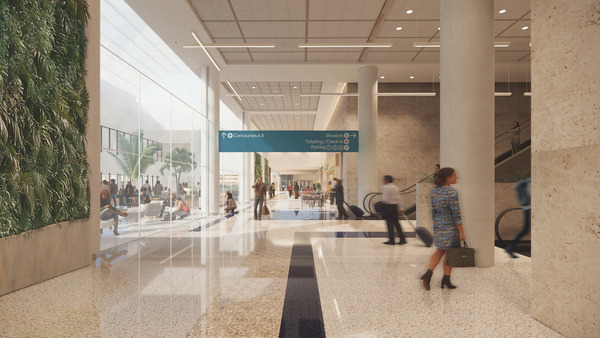
Tom: The phrase “form follows function” is well known and relevant in the design of virtually all building types. For airport, function, which is the process of passenger flow, drives the planning — regardless of airport size. Subsequently, form responds to that plan. Theoretically, airports could be simple extrusions — an envelope that wraps the plan and keeps the rain and snow out with the minimal amount of volume. But that’s not really how we design airports. Because they are public places for relatively large numbers of people, they generally demand bigger, more voluminous spaces, which also is a key driver in overall building form.
Yes, they must be efficient and maintainable, but they also must be inspiring and uplifting, must facilitate the flow of modern flight processes and speak to the specificity of the place in which they are located.
Workforce shortages are affecting nearly every industry. How can EXP’s engineering and technical staff change the way airports plan and deliver capital programs?
Tommy: What sets EXP apart is that our teams understand the business of running an airport, not just designing projects within one. With former airport executives on staff, we’ve lived that experience and approach capital planning through an owner’s lens — an advantage that becomes even more critical as workforce shortages intensify.
Marcos: Staffing challenges are intensifying as airports struggle to hire and retain specialized talent, particularly as many shift from project‑by‑project delivery to managing multiple initiatives simultaneously. Terminal upgrades, parking facilities and airfield work are increasingly delivered as integrated programs rather than standalone projects.
EXP’s strength in program management helps large, mid and small hub airports coordinate complex, concurrent work more effectively. Through staff augmentation and on‑site support, EXP embeds experienced engineering and technical professionals within airport teams to fill critical gaps, maintain momentum and help airports deliver capital programs efficiently despite ongoing workforce constraints.
Where do tools like AI add real value?
Tommy: Artificial intelligence has an important role in aviation, but it is not a replacement for people. AI can support decision-making, improve efficiency and help airports see patterns they might otherwise miss, but the human element makes airports work as a well-connected ecosystem.
A balance between the human element and AI does exist. Our teams are working to make sure that balance works.
To learn more about EXP’s aviation capabilities and the airports we are assisting around the world, contact Tommy Bibb and Marcos Souza.