As the nation’s capital, Washington, DC, presents a uniquely complex transportation and infrastructure environment. The region must accommodate a diverse range of users, including residents, commuters, tourists, government agencies and commercial operators, all of whom place varying demands on the transportation network. These demands are further complicated by the movement of commercial freight, federal and security-related vehicles, and large-scale ceremonial and special events that require careful traffic and load management.
Adding to these challenges is the District’s extensive inventory of historic bridges and structures. Many of these assets were designed under earlier engineering standards and feature complex structural systems that require specialized evaluation to accurately assess their load-carrying capacity. Preserving these critical structures while ensuring public safety and maintaining mobility requires innovative engineering approaches and data-driven decision-making.
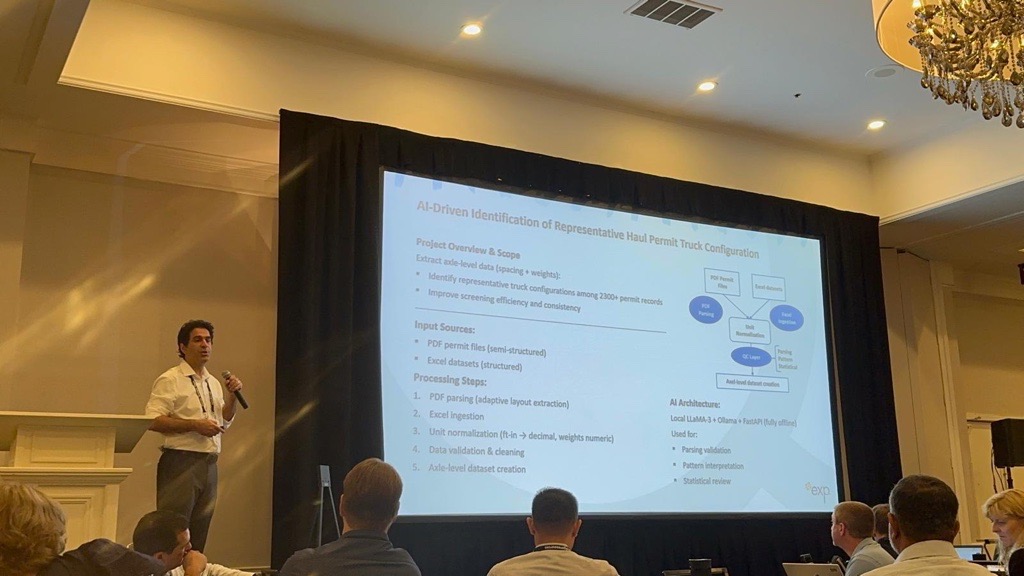
At the 2026 AASHTO Committee on Bridges and Structures Annual Meeting, EXP’s Senior Director of Structures and Bridge, Morteza Rahimi Abkenar, PhD, PE, joined Kamal Elnahal, PhD, PE, and Hongting Zhao, PE, of the District Department of Transportation (DDOT), to discuss the challenges and solutions associated with managing overweight vehicle traffic in constrained urban environments. The presentation highlighted strategies used to balance infrastructure preservation, operational needs and transportation efficiency, while addressing the unique challenges posed by Washington, DC’s historic bridge network and densely developed urban landscape.
Permit evaluation processes and solutions
To support the safe movement of goods, equipment and specialized vehicles throughout the District, DDOT issues permits for oversize and overweight vehicle travel, often requiring detailed engineering evaluations to verify that bridges, tunnels and other transportation assets can safely accommodate the proposed loads. As a trusted partner to DDOT, EXP plays a central role in this process by providing rapid, data-driven structural assessments that help balance infrastructure preservation with operational needs.
EXP’s streamlined evaluation approach enables timely permit reviews, often under accelerated schedules, by screening vehicle configurations, identifying affected assets along proposed routes and assessing available structural capacity information. When a permit request exceeds established thresholds, EXP performs detailed structural analyses to determine whether the vehicle can be safely accommodated and, when appropriate, recommends operational controls such as speed restrictions, designated travel times, escort requirements or alternative routes.
EXP’s partnership with DDOT on transportation projects
EXP is proud to partner with DDOT in preserving and enhancing the safety, reliability and resiliency of Washington, DC’s transportation infrastructure. Serving as a trusted engineering advisor, EXP provides specialized structural expertise to help DDOT address the unique challenges associated with managing critical transportation assets in a densely developed urban environment that includes historic bridges, high traffic volumes and complex operational demands.
From evaluating overweight and oversize vehicle movements to supporting bridge rehabilitation and construction activities, EXP delivers responsive and innovative engineering solutions that help DDOT meet evolving transportation challenges. This partnership reflects a shared commitment to maintaining safe, efficient and durable transportation systems that serve residents, visitors, businesses and federal agencies throughout the nation’s capital.
Some of EXP’s services in support of DDOT include:
- Load rating and structural capacity evaluations for bridges and transportation structures.
- Fast-tracking oversize and overweight haul permit evaluations.
- Bridge rehabilitation design, retrofit and strengthening solutions.
- Construction engineering and inspection support.
- Asset management and technical documentation support to inform maintenance, rehabilitation and capital planning decisions.