By: Pelin Bayrakdar, Senior Quality Assurance Lead | EXP
In an era of increasingly complex infrastructure, success is no longer solely defined by delivering projects on time and within budget. It’s defined by delivering them right — the first time. Yet many large-scale projects still face costly rework, schedule delays and stakeholder challenges due to fragmented and reactive quality practices.
This challenge reflects a fundamental gap: Quality is often treated as a downstream control rather than an integrated system.
Aligning with globally recognized frameworks including ISO 9001 and PMI’s Project Management Professional (PMP) quality management standards, quality assurance (QA) must evolve from a compliance checkpoint into a strategic, proactive, lifecycle-oriented discipline.
ISO 9001 promotes a risk-based, process-driven approach to quality built on customer focus, leadership and continuous improvement. PMI similarly defines quality management as planning, assurance and control across the project lifecycle. When implemented strategically, QA becomes a driver of delivery, risk mitigation and sustained asset performance, resulting in top-notch delivery.
How we view QA:
- A method to help owners and developers under pressure.
- A requirement with an established and credible framework.
- A critical aspect of successful project delivery.
- An actionable item and proven point of success on major infrastructure projects.
Helping owners + developers deliver under pressure
Rising construction costs, complex regulatory frameworks, constrained timelines and evolving funding models are redefining project success and putting extra pressure on infrastructure owners and developers. At the same time, public expectations for safety, sustainability and reliability continue to increase.
Quality assurance isn’t just about compliance; it’s about ensuring confidence in delivery results.
Effective QA frameworks allow teams to:
- Reduce costly downstream rework and claims.
- Ensure compliance with evolving regulatory and safety standards.
- Support predictable project delivery timelines.
- Enhance asset lifecycle performance and sustainability outcomes.
For clients, QA is essential to protecting investment value and ensuring confidence at every stage of delivery of the project. Organizations that implement QA early and consistently are better positioned to manage risk, optimize costs and deliver resilient infrastructure.
For our clients, this alignment translates into tangible value:
- Cost certainty through prevention rather than correction.
- Regulatory compliance that is supported by auditable, standardized processes.
- Schedule reliability via consistent execution and reduced rework.
- Lifecycle performance driven by
Together, these frameworks reinforce that quality checks and processes must be planned, assured and continuously improved — not just inspected at the end.
QA at the center of successful project delivery
At its core, quality assurance should be proactive, data-driven and fully integrated across disciplines. QA is a strategic function that’s aligned with systems thinking, digital tools and collaborative project delivery models rather than a siloed activity.
Quality in action
Across major infrastructure programs, quality assurance has been elevated to a strategic function — delivering consistent, tangible improvements in project , coordination and risk reduction.
Georgia Department of Transportation – SR 400 Express Lanes Project

The SR 400 Express Lanes project is Georgia’s largest transportation infrastructure project and one of the largest public-private partnerships in the United States. It will add express lanes in both directions along a 16-mile stretch of SR 400, from MARTA’s North Springs Station to north of McFarland Parkway. EXP is the Independent Quality Firm on the project.
For large-scale roadway expansion projects, success depends on the ability to maintain consistency across a highly distributed delivery model. With multiple contractors executing parallel work packages — ranging from earthworks and structures to paving and utilities, often across extensive geographic areas — coordination becomes as critical as execution.
Unlike transit megaprojects, where integration is the primary challenge, highway expansions demand disciplined control over standardized processes. The central QA risk is not system integration, but variability because of differences in how contractors interpret specifications, apply quality practices and execute their scopes of work.
Early in the program, the project team identified several key risks:
- Variability in contractor quality practices, leading to uneven execution across
- Inconsistent interpretation of specifications, increasing the likelihood of defects.
- Downstream rework risks caused by misalignment between interconnected work packages.
To address these challenges, a program-wide QA framework was implemented, grounded in ISO-aligned standardization and reinforced by structured quality management practices. This approach introduced clear, consistent expectations across all contractors, supported by defined processes for monitoring, verification and issue resolution.
For this framework to work, it is essential to apply process control and alignment mechanisms so that all teams work under the same standards.
This shift delivered tangible improvements across the corridor:
- Faster resolution of quality issues, reducing disruption to downstream activities.
- Stronger alignment between contractors, minimizing conflicts between work packages.
- Greater consistency in execution, improving overall delivery success.
Project quality assurance is a proactive driver in construction flow. By identifying systemic issues early on and addressing root causes, the project team can reduce repeat deficiencies and improve overall performance.
Key outcomes to date:
- Earlier detection of recurring issues, enabling preventive action rather than repeated correction.
- More effective corrective action cycles, aligned with ISO Clause 10.2 (Nonconformity and Corrective Action).
- Reduced rework, driven by improved coordination and shared understanding of requirements.
By standardizing practices and creating alignment, the SR 400 project demonstrates how structured quality management enables efficiency in a highly dynamic construction environment.
Eglinton Crosstown West Extension Advance Tunnel
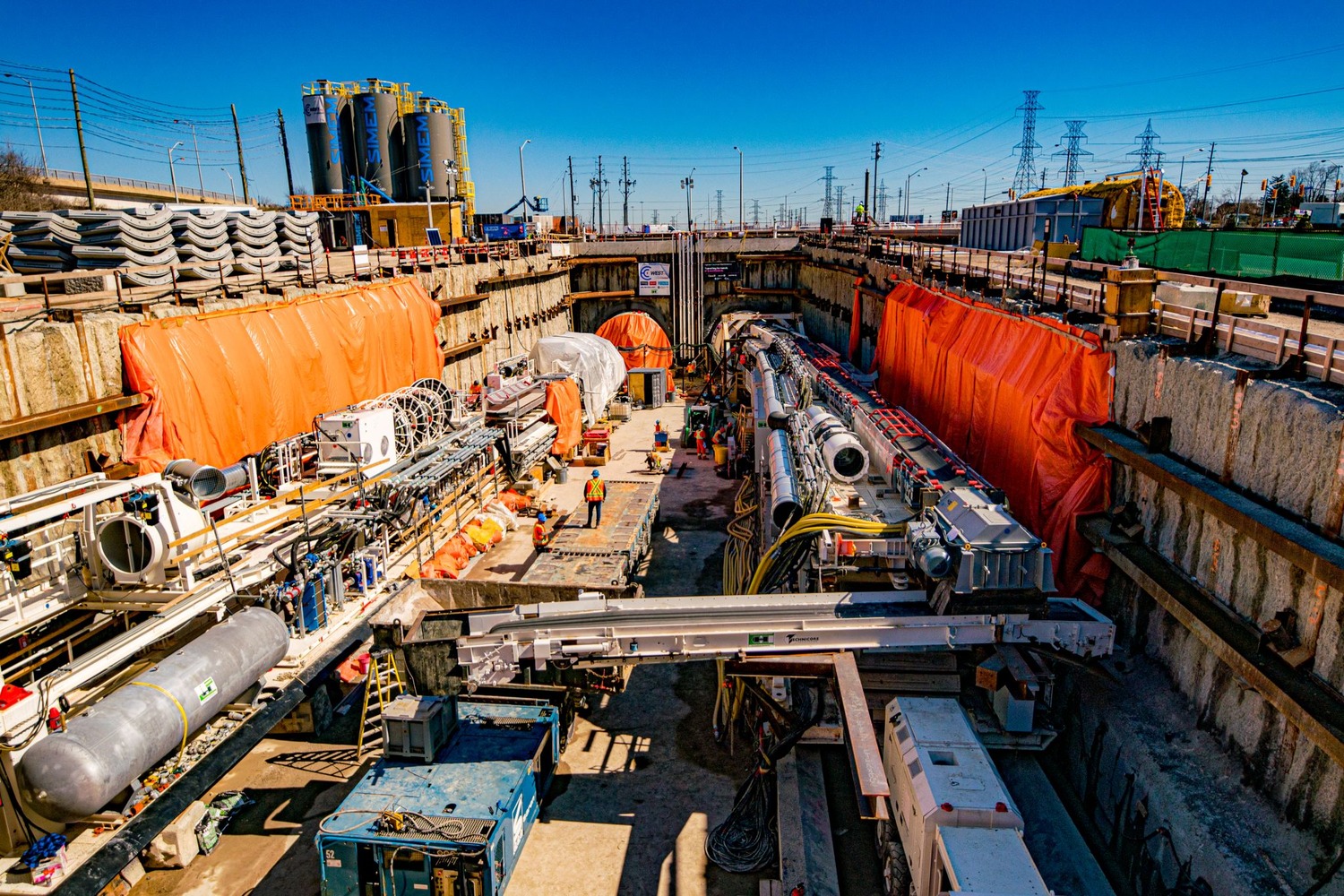
Image courtesy of WestEnd Connectors
The Eglinton Crosstown West Extension, one of Canada’s largest transit infrastructure projects, demonstrates another critical role of QA in delivering complex urban systems. In dense, highly visible environments where technical, logistical and stakeholder challenges converge, QA mitigates risk and safeguards construction quality and long-term operational success.
Delivering light rail infrastructure through an active urban corridor introduces constraints such as limited space, utility conflicts, ongoing community activity and heightened public scrutiny. For the Eglinton West LRT project, maintaining consistent quality under these conditions was essential for executing the project and sustaining public trust and stakeholder confidence.
To address this project’s challenges, EXP adopted a proactive QA strategy focused on continuous on-site assurance rather than end-stage validation. Real-time verification allowed teams to resolve issues at the point of execution, which reduced defects that would have carried into later stages. This approach aligned with ISO Clauses 8.5 and 9.1 and the PDCA cycle.
Continuous on-site inspections conducted under controlled conditions allowed the team to actively manage quality rather than checking it periodically. When defects were identified, immediate corrective action [aligned with ISO Clause 8.7 (Control of Nonconforming Outputs)] and rapid resolution minimized disruption and prevented escalation.
Equally important to the success of the project was the close coordination between design, construction and QA teams. This collaborative model improved communication and accelerated decision-making, which reduced delays often associated with urban transportation interfaces, such as roadway integration and utility relocations.
Detecting issues early to minimize risk
Detecting issues early on reduced reliance on late-stage inspections and minimized costly rework. Construction processes have become more controlled and predictable, particularly in high-risk areas. Faster resolution helped limit disruption to surrounding communities, which is typically an area of concern in dense urban environments.
The QA framework also centered on transparency. Robust documentation and traceability, aligned with ISO Clause 7.5 (Documented Information), created clear audit records and ensured that quality-related decisions were visible and defensible. This level of transparency strengthened stakeholder confidence and supported accountability across all project phases.
The Eglinton West LRT reflects a mature and integrated QA system grounded in continuous monitoring, performance evaluation and corrective action (ISO Clause 10.2).
The approach delivered measurable value:
- Immediate detection and correction of on-site issues.
- Reduction of late-stage corrections, particularly at complex interfaces.
- Faster response to construction challenges.
- Improved coordination across multidisciplinary teams.
- Strengthened relationship with stakeholders through transparent reporting.
By implementing QA into the execution process, rather than treating it as a final checkpoint, the Eglinton West LRT sets a strong benchmark for delivering large-scale transit infrastructure in complex urban settings.
QA as a strategic driver on major infrastructure projects
At EXP, quality assurance goes beyond meeting prescribed standards and extends to enhancing performance, managing risk proactively and delivering certainty in outcomes.
As infrastructure systems become more intricate and interdependent, the role of quality assurance will continue to expand. Highways demand consistency at scale while transit systems require precision across complex interfaces, while both rely on the same disciplined, integrated approach to quality management. ISO 9001 and PMI frameworks provide the essential structure, but the real opportunity lies in how effectively these principles are integrated into execution.
Connect with Pelin to learn how EXP leverages QA to achieve performance, reliability and delivery confidence across road and rail projects.