By: Jay Rao, Director – Environmental Services, Western Canada | EXP
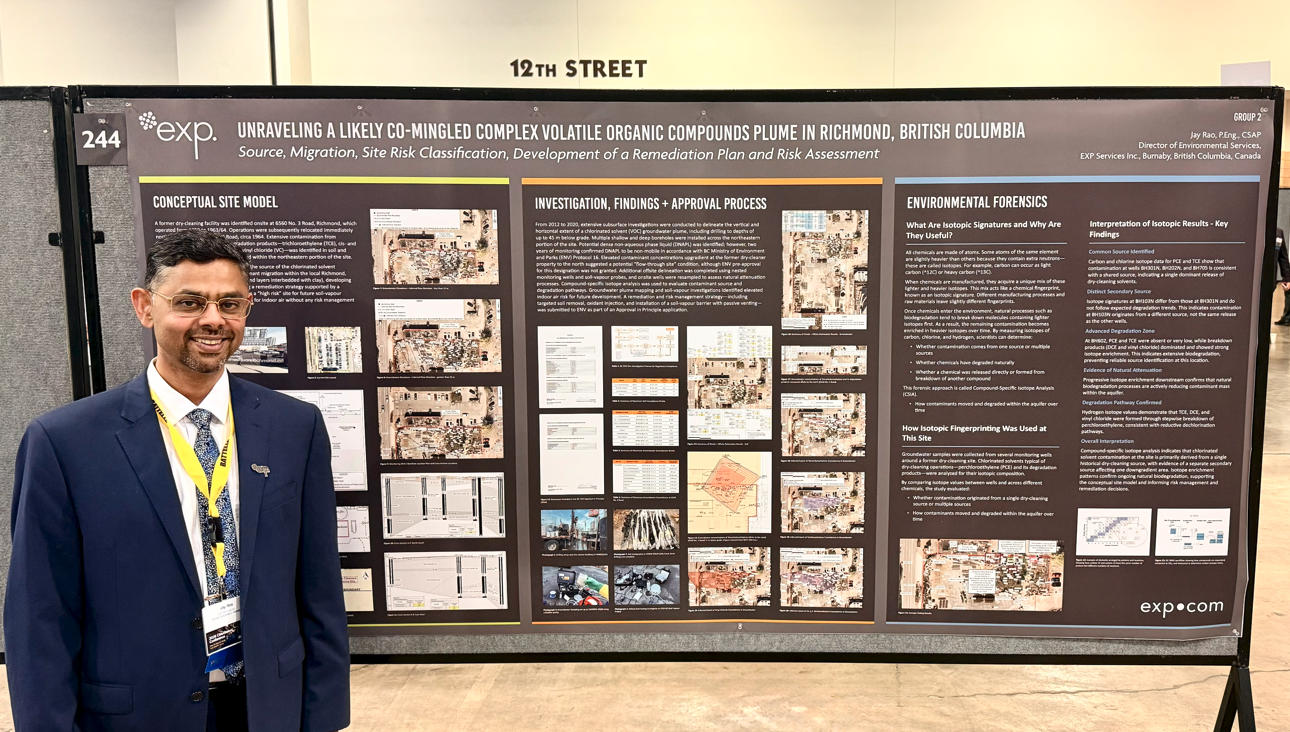
Redeveloping contaminated brownfield sites often requires far more than simply delineating environmental impacts. At a former dry-cleaning property in Richmond, British Columbia, EXP led a complex investigation of a chlorinated solvent plume that had migrated through multiple soil and groundwater units and extended beyond the property boundary. Chlorinated solvent plumes can pose significant risks to human health and the environment by adversely affecting groundwater quality, indoor air quality and soil conditions if not properly managed and remediated.
Over more than a decade, comprehensive site characterization, groundwater monitoring, soil-vapor assessments and conceptual site model development were undertaken to evaluate and manage the contamination. The project team identified elevated concentrations of perchloroethylene (PCE) and its degradation products while assessing potential risks to future site occupants and neighboring properties.
The investigation highlighted the challenges associated with historic releases, potential co-mingled plumes, dense non-aqueous phase liquids (DNAPL) and regulatory compliance within a complex urban redevelopment setting. A risk assessment and risk management approach incorporating a sub-slab soil-vapor barrier was developed to address future hazards, including soil-vapor intrusion into a planned mixed-use commercial and residential high-rise development, as well as potential exposure to contaminated soil and groundwater containing toxic chlorinated compounds. An Approval in Principle was issued by the BC Ministry of Environment and Parks in February 2026.
The work relied heavily on the application of compound-specific isotope analysis (CSIA), an environmental forensic technique that uses isotopic “fingerprints” to better understand contaminant sources and degradation pathways. The isotopic evidence demonstrated that a substantial portion of the chlorinated solvent contamination originated from a common historic dry-cleaning source located offsite. A distinct secondary source was also identified within a portion of the study area.
The analysis further confirmed that contaminants are undergoing natural attenuation within the aquifer. This finding validated the team’s conceptual understanding of the site, provided greater certainty regarding the source and migration of contamination and supported the development of a long-term risk management strategy.
These findings informed a comprehensive remediation and risk management program that combined targeted source removal, in situ treatment, soil-vapor mitigation measures and risk assessment to facilitate future redevelopment. This project demonstrates how integrating environmental forensics, detailed site investigation and regulatory expertise can transform complex environmental liabilities into defensible, science-based solutions.
By leveraging multiple lines of evidence to reduce uncertainty, environmental professionals can more effectively support redevelopment objectives while protecting both human health and the environment.